
Crawl space encapsulation in South of Broad
South of Broad is the southernmost part of the Charleston peninsula, the historic residential district below Broad Street that runs down toward White Point Garden and the Battery. It is what many people picture when they think of Charleston: tall single houses with piazzas, brick and stucco mansions, gas lanterns and narrow lanes. It is also one of the lowest-lying parts of the city, surrounded by tidal water on two sides.
That combination of age, low ground and tidal exposure makes the space under a South of Broad home a demanding environment. Many houses here have stood for well over a century, and their foundations were built for a different way of managing water and air. We help owners of these homes keep the structure dry, protect original framing and control humidity without changing what makes the house special.
What makes South of Broad crawl spaces different
Most crawl space guidance assumes a mid-century house on a flat lot with a standard foundation. South of Broad is not that. Several things set it apart.
Age. Many homes here date from the 1700s and 1800s. Original timber framing, brick piers and lime-based mortar are common. Materials this old behave differently from modern lumber and Portland cement, and they need to be treated with care.
Unusual foundations. Depending on the house, the space below the first floor may be a traditional crawl space, a shallow void between piers, a partial raised basement or a combination of all three. Heights and access vary from one house to the next, and sometimes from one end of the same house to the other.
Tidal exposure. The southern tip of the peninsula floods during high tides and storm surge. Water in the street means higher groundwater under the house, and sometimes water in the crawl space itself.
Historic fabric. Original floor joists and beams may be hand-hewn, irregular and irreplaceable. Replacing them is a last resort, and reinforcing them takes judgment.
Salt in the air and water. Coastal air and brackish groundwater corrode fasteners, ductwork and metal supports faster than inland conditions do.
Homes in South of Broad
The architecture here is among the best known in the country. Charleston single houses, with their narrow side-facing profile and long piazzas, sit beside Georgian, Federal and Greek Revival townhouses and grand freestanding homes. Many are wood-framed on raised brick foundations, and others are masonry throughout.
A few patterns matter for crawl space work. Houses are often raised above grade on piers or masonry walls, with a limited amount of clearance underneath. Many have been altered over the decades, with added plumbing, HVAC systems and wiring snaking through the space. Some have been dug out, filled, patched or partly paved in the past. And many have already been through several rounds of repair, which means we sometimes find a layered history under the floor.
Because of all this, no two homes are alike, and our inspections here run longer. We look at the framing, the piers, the foundation walls, the soil and the way the building has been modified before we recommend anything.
Water, soil and flood conditions in South of Broad
The ground under South of Broad is low and close to the harbor. A few conditions come up on nearly every job.
High tides and sunny-day flooding. King tides push water into streets and gardens even without rain. That raises groundwater around foundations and can saturate soil under the house.
Storm surge and heavy rain. A strong storm can send water well above street level, and the peninsula's older drainage system can be slow to clear.
A shallow water table. In much of the neighborhood, groundwater sits only a few feet down. Bare soil in a crawl space keeps evaporating moisture into the air, even in dry weather.
Brackish water. Where water does reach the crawl space, it often carries salt, which accelerates corrosion and leaves mineral residue on masonry.
Limited drainage options. Tight lots, shared walls and historic constraints can make it hard to move water away from the house, so interior drainage and pumps carry more of the load than they would in a suburban yard.
For homes in a mapped flood zone, we plan the crawl space system knowing that no interior measure will fully protect against a major flood. What we can do is keep ordinary moisture, tidal groundwater and storm runoff from causing long-term damage.
Crawl space problems we see in South of Broad
After many Charleston inspections, some issues turn up more here than elsewhere.
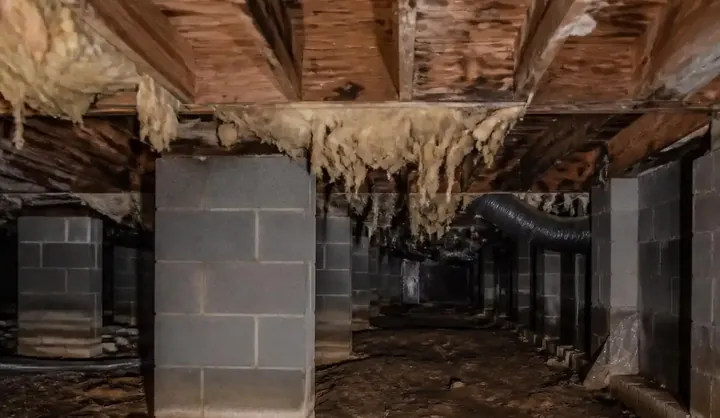
- Wet or fallen insulation and old fiberglass that has been holding moisture against historic subfloor
- Mold on joists and beams, particularly in houses with open vents and bare soil
- Rotting at the ends of joists where they meet damp masonry
- Brick pier mortar that has deteriorated, leaving piers leaning or unstable
- Rusted ductwork, hangers and fasteners
- Old plumbing leaks that have soaked the framing for years
- Pest activity, including termites and rodents, in damp, undisturbed spaces
- Humid air from vents flowing into a space with a dirt or partly paved floor
- Areas of the floor that feel soft, uneven or cold
What we usually recommend in South of Broad
Every recommendation depends on the house, but a few patterns show up.
Gentle, careful cleanout. Historic framing deserves a gentle touch. We clean without damaging old wood, remove debris and failed insulation, and treat any mold. See crawl space cleanout and mold remediation.
Targeted repairs. Where wood is compromised, we favor reinforcing and sistering over replacement, so original timber stays in place wherever it can. See crawl space repair.
Water control. Where groundwater reaches the space, a sealed sump basin, perimeter drainage and a discharge route planned around the lot are often necessary. See drainage and sump pumps.
A sealed liner and sealed vents. A reinforced vapor barrier and vent sealing cut off ground moisture and humid air. Because exterior appearance matters here, we usually seal from the inside.
A properly sized dehumidifier. Humidity control is what keeps the space stable year-round. See dehumidifier installation.
Moisture-tolerant insulation. Where it makes sense, foam board or closed cell spray foam replaces failed batts. See crawl space insulation.
Taken together, these steps make up a complete crawl space encapsulation, adapted to the building.
How the process works in a South of Broad home
- Inspection. We study the space, mapping access, framing, piers, water paths and past alterations.
- A plan that respects the house. You receive a written scope that explains how each step protects the original structure.
- Cleanout and treatment. Debris and failed materials come out with care, and mold is treated.
- Repairs and drainage. Structural issues and water entry are corrected first.
- Sealing. Liner, seams, vents and penetrations are closed.
- Conditioning. Insulation and a dehumidifier finish the system.
- Walkthrough. We show you the result and explain how to monitor it.
Local rules and practical notes
Historic review. Much of South of Broad falls within Charleston's historic districts, where exterior changes are reviewed by the Board of Architectural Review. Most crawl space work happens inside the foundation and does not alter the exterior, which is one reason we seal vents from the inside. If your plan touches anything visible from outside, check with the city first, and we will flag it.
Flood zone rules. Many properties here are in FEMA flood zones, and engineered flood vents may be present or required. We do not block flood vents without understanding the rules that apply to your property, and we recommend confirming with your insurance agent or the city's floodplain office.
Tight access. Crawl space access in older homes can be small and awkward. We plan for it and protect floors and landscaping on the way in and out.
Neighbors and shared walls. In townhouse settings, we coordinate noise and work schedules with consideration for the people nearby.
What crawl space work costs in South of Broad
Pricing here depends heavily on access, the condition of the framing and how much drainage is needed. A dry crawl space with good access is a straightforward job. A tidal, low crawl space with fragile framing, tight access and deteriorating piers is more involved. Because every house is different, we quote after an inspection. Our cost guide shows planning ranges, and nearby homes in Harleston Village and Ansonborough face similar conditions.
Frequently asked questions
Can you work on a historic South of Broad home?
Yes. We approach historic homes carefully, favoring reinforcement over replacement, sealing from the inside and respecting original materials. We recommend checking with the city about any exterior changes.
Will sealing the crawl space change how my house looks?
Usually not. Most of the work happens inside the foundation, and we seal vents from the inside so the exterior stays the same.
My crawl space floods during king tides. Can it be fixed?
We can reduce water entry and install drainage and a sump pump to manage it, but no system can promise a dry crawl space in a major flood. We design for ordinary tidal and storm conditions.
Is encapsulation safe for old timber framing?
When it is done correctly, a dry sealed space protects old framing better than a damp vented one. Keeping humidity in range is the best way to preserve historic wood.
Do I need a permit?
Some structural work may need one, and exterior work in a historic district may need review. We discuss this with you when we write the scope.
How do I schedule an inspection?
Call (877) 720-8173, tell us your street and what you are seeing, and we will get you on the calendar.
Own a South of Broad home with a damp crawl space? Call and we will take a careful look.
Call (877) 720-8173