
Why a sealed crawl space needs a dehumidifier
A vapor barrier and sealed vents stop the big sources of moisture, but they do not remove the moisture that is already in the air or the small amounts that sneak in through the foundation, the plumbing penetrations and the occasional leak. Air in a sealed space also carries whatever humidity it had on the day it was sealed.
A dehumidifier takes care of what remains. It pulls water vapor out of the air, collects it, and sends it out of the space through a drain line or pump. In Charleston, where outdoor dew points sit in the 70s for much of the year, the difference between a sealed crawl space with a dehumidifier and one without is easy to measure and easy to smell.
The target for a healthy crawl space is relative humidity in roughly the 45 to 55 percent range. Mold generally needs sustained humidity above about 60 percent, so holding the space below that line is the real job of the unit.
Not all dehumidifiers are the same
The dehumidifier you buy at a hardware store for a basement is a poor fit for a crawl space. Crawl spaces are cramped, often cool, hard to reach and unattended for months. The equipment has to cope with those conditions.
Crawl space rated units are built for the environment. They are compact, designed to operate at the lower temperatures common under a house, and often include a condensate pump or gravity drain so you never have to empty a bucket.
Capacity matters. A unit that is too small runs constantly and still loses. One that is far too large cycles on and off and does not dry the air evenly. We size the unit to the volume of the space, the condition of the envelope and how much moisture the crawl space still produces.
Drainage must actually work. A dehumidifier that fills a reservoir you never empty is a dehumidifier that stops working. We plumb the unit to a gravity drain where the slope allows, or to a condensate pump or the sump system where it does not.
Airflow matters. In larger or oddly shaped crawl spaces, we may add air movement or ducting so the dry air reaches the far corners rather than leaving damp pockets near the walls.
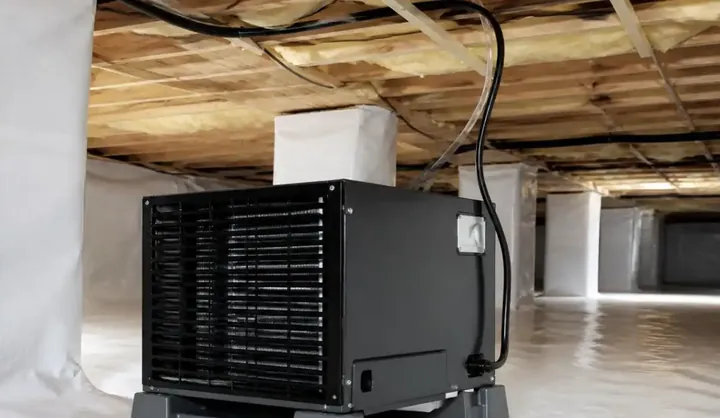
How we install a crawl space dehumidifier
Choosing the location. The unit goes where it can pull from the whole space, stay accessible for service and drain easily. We keep it off the ground, typically on a stand, so it is clear of any moisture that reaches the liner.
Power and safety. The unit needs a dedicated or properly protected electrical connection. We install it in a way that is safe in a damp environment and leaves the space ready for inspection.
Drain setup. We run a drain line that works with gravity where possible, or install a condensate pump. In homes with a sump pump, the dehumidifier can often discharge into the same system.
Sealing the space around it. Dehumidifiers work best in a sealed space. If the vents and gaps are still open, the unit will be trying to dry the outdoors. That is why this service is usually installed as part of full encapsulation, after the liner and vent sealing.
Testing and setting the target. We start the unit, confirm it drains, and set the humidity target. We also show you how to read the display, if your unit has one, and how to know it is working.
Signs your crawl space needs a dehumidifier
A dehumidifier makes sense whenever you have a sealed or mostly sealed crawl space that is still damp, or when you are planning an encapsulation. Look for:
- A crawl space that has a liner but still smells musty
- Humidity readings above 60 percent
- Condensation on ducts, pipes or the underside of the subfloor
- Visible mold or mildew on framing
- Rust on ductwork, hangers or fasteners
- Floors that feel cool, soft or damp
- High humidity in the house despite a working air conditioner
Why a dehumidifier alone is rarely enough
Homeowners sometimes ask whether they can just drop a dehumidifier in an open crawl space. In Charleston, that rarely works. An open crawl space brings in more humid air than any unit can handle, and the unit will run constantly and fail early.
The right order is to stop the moisture sources, then dry what is left. That means drainage if there is water, a vapor barrier over the ground, sealed vents and air gaps, and then the dehumidifier to hold the space in range. We will tell you if a dehumidifier by itself is a reasonable first step for your home, which happens occasionally in already well-sealed crawl spaces.
Maintenance and what to expect
A crawl space dehumidifier is low maintenance, but not maintenance-free.
- Check that it is running. A quick look at the display or a listen at the access door tells you if it is on.
- Confirm the drain. If water backs up or the pump stops, the unit shuts off. Check the line occasionally.
- Clean or replace the filter. Follow the manufacturer's schedule. A clogged filter reduces capacity and shortens the life of the unit.
- Expect power costs. Running a dehumidifier uses electricity, but a sealed crawl space typically needs far less drying than an open one.
- Plan for eventual replacement. Like any appliance, the unit will wear out. Many last for years with basic care.
Energy use and your bills
The electricity a crawl space dehumidifier uses depends on the size of the unit and how much moisture it removes. In a properly sealed and insulated space it runs much less than in a leaky one. Because the crawl space no longer feeds humid air into the house, your air conditioner often has less moisture to remove as well. Results differ from home to home, so we do not promise a specific savings figure, but a dry sealed crawl space is rarely the reason for a high power bill.
What dehumidifier installation costs in Charleston
The cost depends on the unit we select, the drain setup and whether the space is already sealed. A standalone installation in a well-sealed crawl space costs less than one that is part of a full encapsulation where vents, liner and drainage are all being addressed. We give you the equipment and installation scope in writing after an inspection. See our cost guide for planning ranges on full projects.
Why Charleston homeowners call us for dehumidifiers
Because we come from mold inspection and remediation, we think about what the humidity reading means rather than just which box to plug in. We size the unit to the space, plumb it to drain and make sure the envelope around it supports it. We work in neighborhoods from the historic peninsula to West Ashley, James Island and Daniel Island, where crawl space conditions vary from block to block.
Questions to ask before you buy a crawl space dehumidifier
Equipment choices matter more here than people expect, and a few questions help you compare quotes fairly.
- Is the unit rated for crawl space conditions, including cooler temperatures?
- How was the size chosen, and what is the volume of my crawl space?
- Where will the water drain, and what happens if the pump fails?
- Will it show a humidity reading, or will a separate monitor be added?
- What does the manufacturer cover, and what does your installation cover?
- Is the space sealed well enough for the unit to work?
If a contractor proposes a dehumidifier without mentioning vents, the liner or drainage, they are selling you equipment, not a solution.
Frequently asked questions
What humidity level should a crawl space be?
A good target is 45 to 55 percent relative humidity. Above about 60 percent for long periods, mold and wood decay become a real risk.
Can I use a regular household dehumidifier in my crawl space?
It is not recommended. Household units are not built for the cool, cramped, unattended conditions under a house, and they require manual emptying unless modified. Crawl space rated units are built for this job.
Will a dehumidifier run all the time?
It will run more in the first weeks as it removes stored moisture, then cycle on and off. A unit that never stops usually means the space is not sealed well or water is still entering.
Where does the water go?
Into a drain line or condensate pump that carries it out of the crawl space. We set that up during installation.
Do I still need a vapor barrier?
Yes. The liner keeps ground moisture from evaporating into the air faster than the dehumidifier can remove it. See vapor barrier installation.
How do I know it is working?
Many units show the humidity reading. If yours does not, we can install a small humidity monitor, and a dry, odor-free crawl space is a good sign.
Not sure what size dehumidifier your crawl space needs? Call and we will find out.
Call (877) 720-8173