
What crawl space encapsulation is
Crawl space encapsulation turns the area under your home from a vented, damp, open space into a sealed and controlled one. Instead of letting outside air blow through and hoping the space dries out, we close it off from the soil and from the weather and manage the humidity inside.
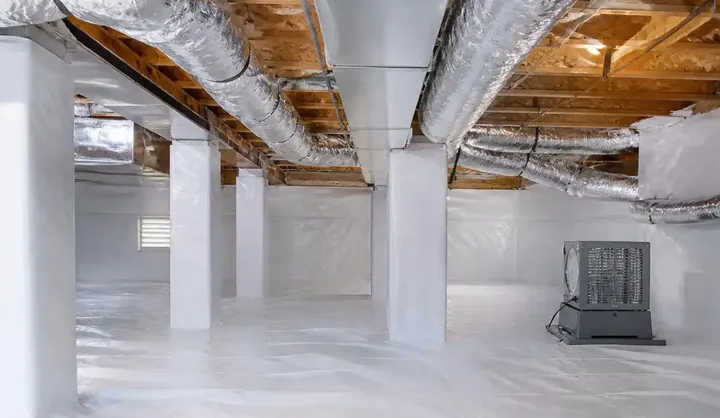
A complete encapsulation has five working parts: a heavy-duty vapor barrier over the ground and up the walls, sealed foundation vents and air gaps, insulation where the plan calls for it, a dehumidifier sized for the space, and drainage if water is entering. Take any one of them away and the system works less well. Put them together and the crawl space stops being a source of moisture for the rest of the house.
Why encapsulation fits Charleston so well
Encapsulation is useful in many places, but Charleston is nearly a textbook case for it. Three conditions stack up here.
Humid air nearly all year. Summer dew points commonly reach the 70s. When that air flows through open foundation vents into a cooler crawl space, it condenses on framing, ductwork and the underside of the floor. Wood that stays damp invites mold and decay.
A shallow water table. Across the peninsula, James Island, West Ashley and the marsh edges, groundwater sits close to the surface. Bare soil under a home gives off moisture continuously. A crawl space with a dirt floor is, in effect, a large evaporating surface under your living room.
Tides, storms and heavy rain. Charleston gets roughly fifty inches of rain a year, plus tidal flooding that can lift groundwater under nearby homes even on a dry day. Water that cannot drain away ends up in the crawl space.
A vented crawl space was built for a different climate and an older understanding of building science. Sealing and conditioning the space is the modern answer, and the International Residential Code, which South Carolina follows, recognizes unvented, conditioned crawl spaces when the right components are in place.
What is included in our encapsulation
Every job is scoped to the home, but a complete encapsulation includes these steps.
Inspection and moisture readings. We look at the whole space, measure humidity and wood moisture, and document what we find.
Cleanout and preparation. Debris, wet or fallen insulation and anything organic that can feed mold is removed. Surfaces are cleaned and treated where needed. Our page on crawl space cleanout covers this in detail.
Repairs and drainage first. If framing is damaged or water is entering, we fix those before sealing. See crawl space repair and drainage and sump pumps.
Vapor barrier installation. A reinforced polyethylene liner covers the ground and extends up the walls and around piers. Seams are overlapped and sealed, and penetrations are sealed too. More on the vapor barrier page.
Vent sealing and air sealing. Foundation vents are closed and sealed, along with gaps and penetrations that leak outside air. See vent sealing.
Insulation. Where the plan calls for it, foundation walls are insulated with spray foam or rigid foam board so the space stays temperate. See crawl space insulation.
Dehumidifier. A unit sized to the volume of the space holds humidity in a safe range and drains out of the space. See dehumidifier installation.
Materials that matter
Not all liners and installations are equal, and this is where cheap encapsulation jobs fall apart.
The liner should be a reinforced, multi-layer polyethylene made for crawl spaces, typically in the 12 to 20 mil range, rather than thin builder plastic that tears the first time someone crawls over it. Seams need to be overlapped by several inches and sealed with a tape made for the material, and the liner should be fastened and sealed to the walls and piers rather than simply laid on the dirt.
Insulation should be a type that tolerates moisture. Fiberglass batts hold water and fall away from the floor, so we avoid them in crawl spaces. Closed cell spray foam and rigid foam board do not absorb moisture the way batts do.
The dehumidifier should be a crawl space rated unit, not a household model, with a drain or pump that actually gets the water out of the space.
Signs your crawl space needs encapsulation
You do not need all of these. Even one is worth taking seriously.
- A musty or earthy smell inside the house, especially near floors or after rain
- Visible mold or mildew on joists, subfloor or foundation walls
- Wet, sagging or fallen fiberglass insulation
- Standing water, wet soil or condensation on ducts and pipes
- Rust on ductwork, fasteners or metal supports
- Floors that feel cold, soft, bouncy or uneven
- Doors and windows that stick in humid weather
- Pest activity such as termites or rodents
- Higher cooling bills than similar homes nearby
Our encapsulation process
Our process is built to prevent the most common failure in this industry, which is sealing over a problem that was never fixed.
- Inspect and measure. We assess moisture, framing, ductwork, drainage and access, and show you what we see.
- Write the scope. You get a written plan listing exactly what will be installed.
- Clean and treat. The space is cleared of debris and treated where mold or contamination is present.
- Fix the cause. Water entry and structural damage are corrected first.
- Install the liner and seal. Liner, seams, piers, vents and penetrations are sealed.
- Insulate and condition. Insulation and the dehumidifier complete the system.
- Walk the finished space with you. We explain how it works, what to monitor and how to keep it healthy.
What encapsulation costs
The price depends on size, condition and which components your home needs. A clean, dry crawl space is the low end of the range. Standing water, heavy debris, active mold or structural repair push the number up. We keep a current set of planning ranges on our encapsulation cost guide, including an estimator, but the real quote comes after an inspection. Beware of any price quoted without anyone looking at the space.
Maintaining an encapsulated crawl space
An encapsulated crawl space is low maintenance, not no maintenance. A few habits keep it working.
Check the dehumidifier occasionally to confirm it is running and draining. Keep an eye on the humidity reading if your unit displays one; you want it in the neighborhood of 45 to 55 percent. Look at the liner after any major storm or if anyone else has been in the space. If you have a sump pump, test it now and then by pouring water into the pit. And call us if you notice a new smell, a new stain or anything that looks different from the day we finished.
Questions to ask any crawl space contractor
Encapsulation is a category where the quality gap between companies is enormous, and the difference is rarely visible once the work is finished and the liner is down. A few questions separate careful installers from the rest.
- Will you go into the crawl space and take readings before quoting, or is this a phone price?
- What thickness and type of liner will you use, and how are the seams and walls sealed?
- What happens to the existing insulation and debris?
- How will the space be dried, and what size dehumidifier is included?
- If water is entering, what is the drainage plan?
- Who will be doing the work, and who do I call afterward?
A good answer is specific. A vague one usually means the scope is thin. You deserve a written plan that names the materials and the work in plain language.
Frequently asked questions
How long does encapsulation last?
A properly installed liner and sealed system can last many years. The dehumidifier is the component most likely to need service or replacement over time, as with any appliance. Ask us about the warranty coverage on the materials and equipment for your job when you call.
Can I encapsulate only part of the crawl space?
Partial encapsulation rarely works. Moisture moves to wherever the barrier is incomplete, and humid air in the unsealed section reaches the rest. If budget is the concern, talk to us about phasing the work in the right order, starting with drainage and cleanout.
Do I need to remove old insulation?
Often yes. Wet or fallen fiberglass insulation holds moisture against the floor and can harbor mold. We remove it during cleanout and replace it with moisture-tolerant insulation if the plan calls for it.
Is it safe to leave my vents closed in winter?
Yes. In a sealed and conditioned crawl space, the vents are no longer part of the design. The dehumidifier and the liner manage moisture year-round.
Will encapsulation stop termites?
Encapsulation removes the damp, hidden conditions pests like, but it is not a termite treatment. Keep up with regular termite inspections and let us know about any activity so the plan accounts for it.
What does it cost to encapsulate a crawl space in Charleston?
It varies with size and condition. Our cost guide shows planning ranges, and an inspection gives you a real number.
Want a straight answer on your crawl space? Call and we will get an inspection scheduled.
Call (877) 720-8173