
Why mold thrives in Charleston crawl spaces
Mold needs four things: spores, a food source, the right temperature and moisture. Spores are everywhere. Wood framing is food. Charleston temperatures are mild for most of the year. That leaves moisture as the only variable you control, and in a vented Lowcountry crawl space, moisture is nearly always available.
Warm humid air enters through foundation vents and meets cooler wood, ductwork and soil. Relative humidity at the wood surface climbs above 60 percent, condensation forms, and mold begins to grow. Sustained humidity at those levels is all it takes. Add a dirt floor that continuously evaporates ground moisture, wet insulation that holds water against the subfloor, and little or no airflow in the corners, and a crawl space becomes an ideal incubator.
That is why we say mold is a symptom. The mold on the joists is telling you the moisture control has failed. If you remove the mold and leave the conditions in place, it comes back.
What mold in a crawl space looks like
Mold shows up in different forms, and color alone does not tell you what kind it is or how serious it is. Look for:
- White, fuzzy or powdery patches on joists, subfloor or foundation walls
- Black, green or gray spotting or staining on wood
- Dark streaks that follow the grain of the framing
- A musty, earthy odor in the crawl space or in rooms above it
- Mold growing on fallen or wet insulation
- Mildew on the vapor barrier or on stored items
- Wood that looks darkened, feels damp or soft to a screwdriver
White growth is not always mold. Efflorescence on masonry and some wood surface salts can look similar. An inspection tells you which it is.
Mold, wood rot and what each means
Mold and rot are related but not the same. Mold is a surface growth that feeds on wood and other organic material. It stains and smells and can affect indoor air. Wood rot is decay caused by fungi that break down the wood itself. Rot weakens framing.
Surface mold on solid wood can often be cleaned. Rotted wood has to be repaired or replaced. We look for both during inspection, and if rot is present, we bring in the structural scope covered on our crawl space repair page.
Our mold remediation approach
Because our background is in certified mold inspection and remediation, we follow a sequence that matches how remediation is supposed to work.
1. Inspect and document. We look at the extent of growth, the materials affected and the moisture sources. We take readings and photographs.
2. Fix the moisture source. This is the step that decides whether the work lasts. We identify whether the cause is humid air, groundwater, a plumbing leak, a failed liner or a combination, and the plan addresses it. See waterproofing and drainage.
3. Contain and protect. We take steps to limit the spread of spores to the rest of the home during work. Crawl spaces connect to living spaces through the floor, so containment matters.
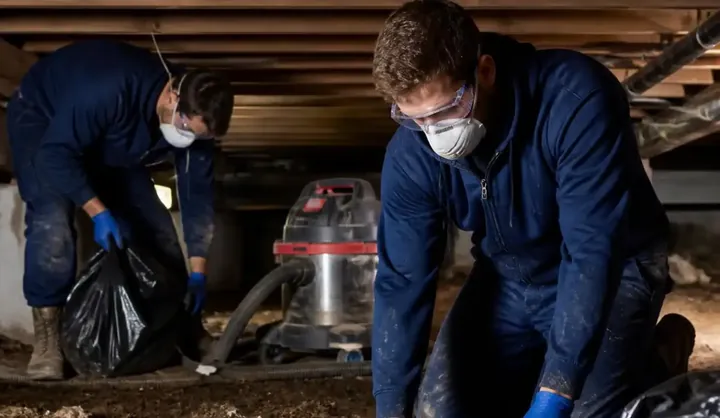
4. Remove contaminated materials. Wet or moldy insulation, debris and materials that cannot be cleaned are removed and bagged.
5. Clean the surfaces. Affected wood is cleaned using methods suited to the material, such as HEPA vacuuming and mechanical cleaning, to remove growth rather than just coat it.
6. Apply an antimicrobial treatment. A treatment is applied to cleaned surfaces according to product directions.
7. Dry and seal the space. A vapor barrier, sealed vents and a dehumidifier keep humidity below the level mold needs.
8. Walk through and follow up. We show you the cleaned space and explain what to watch for. If your situation calls for post-remediation testing, we discuss it with you.
Why not just spray it with a chemical
Some companies offer to spray mold with a coating or fogging product and call it done. That approach has real limits.
Coatings and sealants over mold hide it without removing it. Fogging may reach surfaces but does not clean them. Neither does anything about the moisture that grew the mold. In a few months the humidity returns and the growth shows through again.
Effective remediation removes growth from the surface, removes materials that cannot be cleaned, and then fixes the conditions. Treatments are a part of that process, not a replacement for it.
Protecting your home and your family
Crawl space air does not stay in the crawl space. Through the stack effect and gaps around ducts, plumbing and floor penetrations, a meaningful share of it reaches the rooms above. A moldy crawl space can contribute to a musty smell indoors and can aggravate allergy and asthma symptoms in some people. We do not diagnose health problems, and anyone with health concerns should talk to their doctor, but reducing mold in the crawl space is a reasonable step toward better air in the home.
If anyone in your household has a respiratory condition or a weakened immune system, tell us at the start so we can plan containment and scheduling accordingly.
Do I need mold testing?
Visible mold in a crawl space often does not need lab testing to justify cleaning, because the fix is the same: remove it and control the moisture. Testing can be useful in specific situations, such as real estate transactions, insurance claims or when a family member has health concerns and you want documentation. We can explain when it makes sense and when it would only add cost.
Signs your crawl space needs mold remediation
- Visible growth on framing, subfloor, insulation or walls
- A persistent musty smell that gets worse in humid weather
- Wet, stained or sagging insulation
- Humidity readings above 60 percent
- Condensation on ducts, pipes or wood
- A recent leak, flood or standing water
- Allergy-like symptoms that seem worse indoors, which are worth discussing with your doctor
- A home inspection report that notes mold or high moisture in the crawl space
What crawl space mold remediation costs in Charleston
Cost depends on how much of the space is affected, what materials must be removed, how difficult the access is and what moisture work comes with it. Light surface growth on a limited area costs far less than widespread contamination with insulation removal and structural work. Remediation is usually combined with encapsulation because the mold will return without it. Our cost guide lists planning ranges for mold remediation as an add-on.
Why Charleston homeowners choose us for mold work
We started in certified mold inspection and remediation across the Lowcountry, and that experience shapes how we approach every crawl space. We do not seal over problems, and we do not treat mold as a one-day spray job. We find the moisture, clean the space properly, and set it up so it stays dry. We work in neighborhoods from the peninsula to West Ashley, James Island and Daniel Island.
Questions to ask any mold remediation company
Mold work is a field with a lot of marketing and uneven practices, so it pays to ask pointed questions.
- Will you identify and fix the moisture source, or just clean the mold?
- What method do you use to remove growth from wood, and what is the treatment?
- How will you keep spores from spreading to the rest of the house?
- What is the scope in writing, and what is excluded?
- Will you do post-remediation verification if I ask?
- What happens if the mold returns?
Be wary of anyone who promises permanent results without addressing moisture, or who recommends coating over mold. Remediation that lasts starts with the cause.
Staying safe during and after remediation
Mold work should be done by people who know how to protect themselves and your home. Our crews use respiratory protection, protective clothing and HEPA filtration, and they control how dust and debris leave the crawl space. After work, we recommend keeping the space sealed and dry rather than going in casually. If anyone in your household has asthma, allergies or a compromised immune system, tell us before the job so we can adjust containment and scheduling.
Frequently asked questions
Is crawl space mold dangerous?
It can contribute to indoor air quality problems and a musty smell, and it can damage wood over time. Health effects vary from person to person, so talk to your doctor if anyone in your home has concerns.
Can mold come back after remediation?
It can if the moisture returns. That is why we pair remediation with moisture control, including a liner, sealed vents and a dehumidifier.
Can I clean it myself with bleach?
Bleach is not a good fit for porous wood. It does not penetrate the material, and the moisture it adds can help regrowth. Working in a crawl space without proper protection also exposes you to spores and contaminants.
How long does remediation take?
Small jobs can be done in a day. Larger jobs, especially those that include insulation removal, drying time and repairs, take longer. We give you a timeline after inspection.
Will my insurance cover it?
Coverage depends on your policy and the cause of the moisture. We can provide documentation of what we find, but we cannot advise on coverage.
Do you remove and replace insulation?
Yes. Wet or moldy insulation is removed during remediation and can be replaced with moisture-tolerant insulation.
Smelling mold or seeing it on your joists? Call and we will take a look.
Call (877) 720-8173