Summerville, SC
Crawl Space Encapsulation in Summerville, SC
Summerville didn’t earn the nickname “Flowertown in the Pines” by accident — the same shade and soil that keep the azaleas blooming also keep crawl spaces damp most of the year. We handle encapsulation, repair, and moisture control from the Historic District to Nexton.
Locally owned & operated
Licensed & insured
We know Summerville’s soil
Local conditions
Why Summerville Crawl Spaces Stay Damp Longer Than People Expect
Summerville sits inland, and a lot of homeowners assume that means less crawl space risk than closer to the coast. It doesn’t — it just means a different cause.
The area’s sandy-clay soil holds water differently than marsh or tidal ground, and the heavy pine and oak canopy that gives Summerville its character also shades the ground and slows how fast it dries out after rain.
We handle crawl space encapsulation, repair, and moisture control across Summerville — from century-old cottages near Hutchinson Square and Main Street to newer construction in Nexton and Cane Bay.
Below is what each service actually looks like here, grounded in Summerville’s specific soil and tree cover, not a generic write-up with the town name swapped in.
Our services here
Crawl Space Services in Summerville, SC
Everything below applies specifically to Summerville conditions — skim the bold callouts, or read the full breakdown.
01 : Summerville Crawl Space Repair
Summerville sits on sandy-clay soil, and that soil doesn’t stay still. It expands when it’s wet and pulls back when it dries out, and that constant movement puts slow, uneven pressure on piers and foundation walls — different from the sudden settling you’d see on a filled marsh lot, but just as real over time. We see it most in older homes near Hutchinson Square and the Historic District, where original framing has been riding that shrink-swell cycle for decades.
Newer construction out in Nexton and Cane Bay isn’t exempt either. Five-year-old framing can develop the same kind of uneven settling if the soil underneath hasn’t stabilized yet — new doesn’t mean immune, just less obvious.
We inspect before we quote. On clay soil in particular, what looks like a simple joist repair from the surface sometimes turns out to be a foundation-level shift that requires a different fix entirely. Read more about crawl space repair
Clay soil doesn’t shift suddenly — it moves slowly, for years, until you notice a door that won’t close.
02 : Crawl Space Waterproofing Summerville, SC
Waterproofing in Summerville looks different from what it does closer to the coast. No tidal water or storm surge is pushing up from below — the issue here is usually water that has nowhere to go. Sandy-clay soil doesn’t drain the way sandy coastal soil does, and many Summerville lots sit shaded under a heavy pine and oak canopy, which slows evaporation even after the rain stops.
The result is ground that stays damp for days at a time rather than draining off in a few hours. If your crawl space feels consistently humid rather than actually flooded, that’s usually the reason. Read more about waterproofing here
Not flooding — just water with nowhere to go. Shaded, slow-draining ground stays damp longer.
03 : Vapor Barrier Installation Summerville, SC
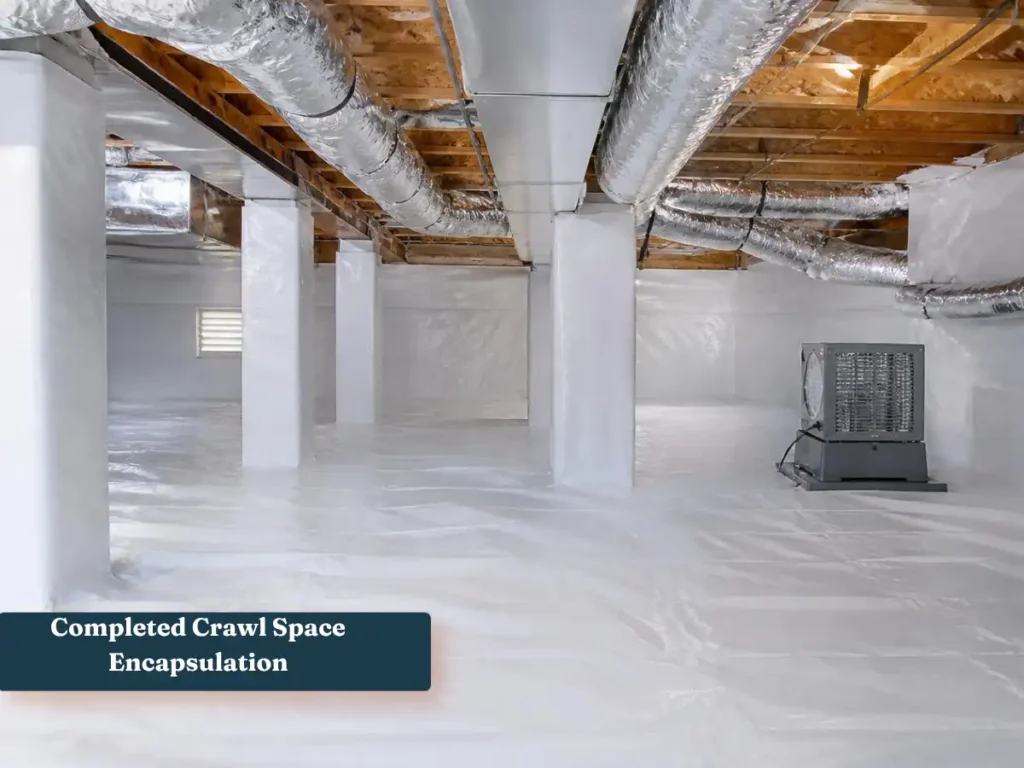
A vapor barrier stops ground moisture from turning into humidity inside your crawl space, and in Summerville that moisture has more time to build up than it would on faster-draining ground. Shaded, sandy-clay lots stay damp longer after rain, which means the barrier is doing more constant work here than it would in a drier part of the state.
We use the same 20-mil, properly sealed barrier standard we use everywhere in the Lowcountry — installed against the walls, not just laid across the floor, and taped at every seam. On older Summerville homes with lower crawl space clearance, that installation takes more care and more time.
Same 20-mil standard everywhere in the Lowcountry — installed with more care on lower-clearance older homes.
04 : Drainage Solutions & Sump Pump Summerville, SC
Standing water in a Summerville crawl space usually traces back to one of two things: grading that sends rainwater toward the house instead of away from it, or gutters and downspouts clogged with pine needles and debris that redirect water somewhere it shouldn’t go. Both are common enough here that we check them as part of every drainage assessment.
Where a real drainage problem exists, the fix is the same French-drain-and-sump-pump approach we’d use anywhere. What’s different in Summerville is how often the actual cause turns out to be something simpler, like a downspout dumping water four feet from the foundation instead of twenty.
Half the time it’s not a drainage system you need — it’s a downspout redirected four feet further from the house.
05 : Crawl Space Dehumidifier Installation Summerville, SC
The tree canopy that gives Summerville its Flower Town character is also part of why crawl space humidity lingers here. Shade keeps the ground cooler and slower to dry, which means the air in an unencapsulated crawl space tends to stay more consistently humid than it would on an open, sun-exposed lot.
We size dehumidifier units to the actual crawl space, not the home’s square footage — which matters more in older Summerville Estates ranch homes and cottages near downtown than people expect, since these homes often have unusual crawl space shapes a generic unit doesn’t handle well.
Shade keeps the ground cooler and slower to dry — which means more consistent humidity underneath.
06 : Crawl Space Insulation Summerville, SC
A lot of Summerville’s housing stock dates back to the 1950s — wood-frame cottages with original insulation that’s been sitting in a humid, shaded crawl space for seventy-plus years. That insulation is usually long past doing its job, sagging or fully detached from the subfloor by the time we get under the house.
Replacing it only works if the moisture source gets addressed at the same time — otherwise new insulation just fails the same way on the same timeline. This comes up constantly in Summerville Estates and Summerville Hills, where the ranch-style housing stock is roughly the same age across entire streets.
Original 1950s insulation has usually been failing quietly for decades by the time we see it.
07 : Crawl Space Cleaning Summerville, SC
Pine trees are part of what makes Summerville Summerville, but they also mean crawl spaces here collect more organic debris than most — needles, bark, and leaf litter that work their way in through vents and foundation gaps over the years. That debris holds moisture against the ground and gives pests somewhere to nest.
We clear all of it out before any barrier goes in, along with checking for termite or carpenter ant activity, which the combination of pine, shade, and moisture tends to attract more than a drier, more open lot would.
Pine debris and pests go hand in hand — we check for both before any barrier goes down.
08 : Crawl Space Inspections Summerville, SC
Whether you’re closing on a century-old cottage near Main Street or a five-year-old build in Cane Bay, a crawl space inspection tells you what you’re actually buying — or what you’re about to sell. Older homes carry more unknowns simply from age; newer construction carries its own risk if a builder rushed the vapor barrier or skipped proper grading to hit a deadline.
We do straightforward inspections either way — photos, a plain explanation, and a real answer, including when the answer is that everything’s fine.
Century-old cottage or five-year-old build — both carry risk, just different kinds.
Reviews
What Charleston home owners say about us.